AIR CANADA WINS LATEST LABOUR DISPUTE AGAINST ITS FLIGHT ATTENDANTS
99 per cent of union members voted to reject the agreement, settled by arbitration.
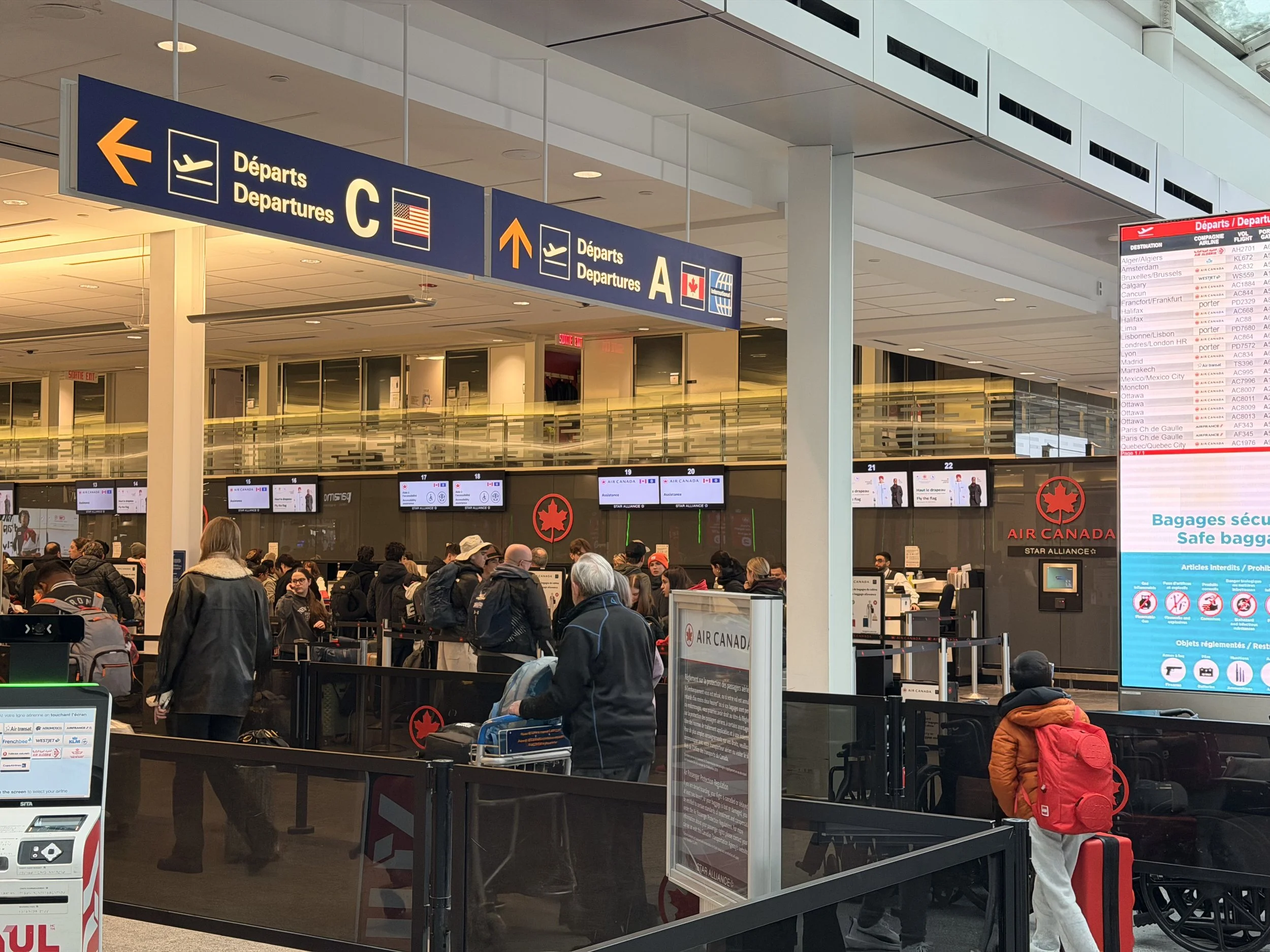
The new agreement will be effective until 2029. The Air Canada component of the CUPE plans to keep fighting in the future.
PHOTO: Lucas Sodano, Feb. 25, 2026
On Feb. 17, 2026, Arbitrator Paula Knopf issued a decision that concluded the wage rate dispute between Air Canada and its flight attendants’ union across the country. The decision was to enforce the new wage agreement proposed by the airline company following a strike by the The Canadian Union of Public Employees (CUPE) that lasted almost four days last August.
The new agreement includes a wage rate increase of 12 per cent in the first year, three percent in the second year, followed by another 2.5 per cent increase in the third year and a 2.75 per cent in the fourth year. This proposal was previously rejected almost unanimously by union members. In a press release, the union representatives said that “This is not the outcome the Union fought to achieve.”
“A lot of us are not happy. The morale at work was already down in August, but it has gone way down,” said a flight attendant who requested to remain anonymous in order to protect their job. Air Canada flight attendants requested wage increases that would be higher, in accordance with industry standards and inflation.
« In my opinion, these rate increases are embarrassing when we compare them to the ones that the Air Canada pilots received. The pilots got 42 per cent over four years.,” said Marc Ranger, the former Quebec director of the CUPE.
Ranger thinks the union settled for this agreement to avoid important fines that would have weakened them financially. “It is pretty exceptional that a union, by itself, would give up its legitimate right to strike. I was very surprised by that,” He said.
In addition to wage increases, the issue at the center of the labour dispute was ground pay for duties performed when planes are not in the air, and during which flight attendants are not paid. During the strike, union members adopted the slogan “unpaid work won’t fly”. The CUPE claims that, on average, flight attendants work 35 unpaid hours every month.
Following the August strike, the federal minister of jobs and families Patty Hadju launched a probe on unpaid work in the airline sector to investigate claims made by flight attendants and the union. In a report released on Feb. 12, 2026, the federal government concluded that they do not have enough data to confirm the claims of unpaid work made by union members.
Flight attendants were also unhappy with the initial findings from the report. “It is unfair to us because we posted our T4, we said it out loud, we went on strike about it for almost four days,” said the anonymous cabin crew member. “Just the other day I did a shift of 11 hours, but I was paid for 7 because we are only paid for our flight time credit,” they added.
This conclusion was not well received by the Air Canada arm of the CUPE. Contacted by email, CUPE vice president Theresa Mitchell said:
“It is our opinion that the government is certainly able to make changes for workers and to ensure all work is compensated. They have chosen to require a huge undertaking on behalf of all airline worker unions to put in the work and to provide data which can then be interpreted in a way that is not necessarily siding with the workers.”
The new collective agreement will be effective until 2029. Mitchell said the CUPE plans to keep fighting for its members after that.